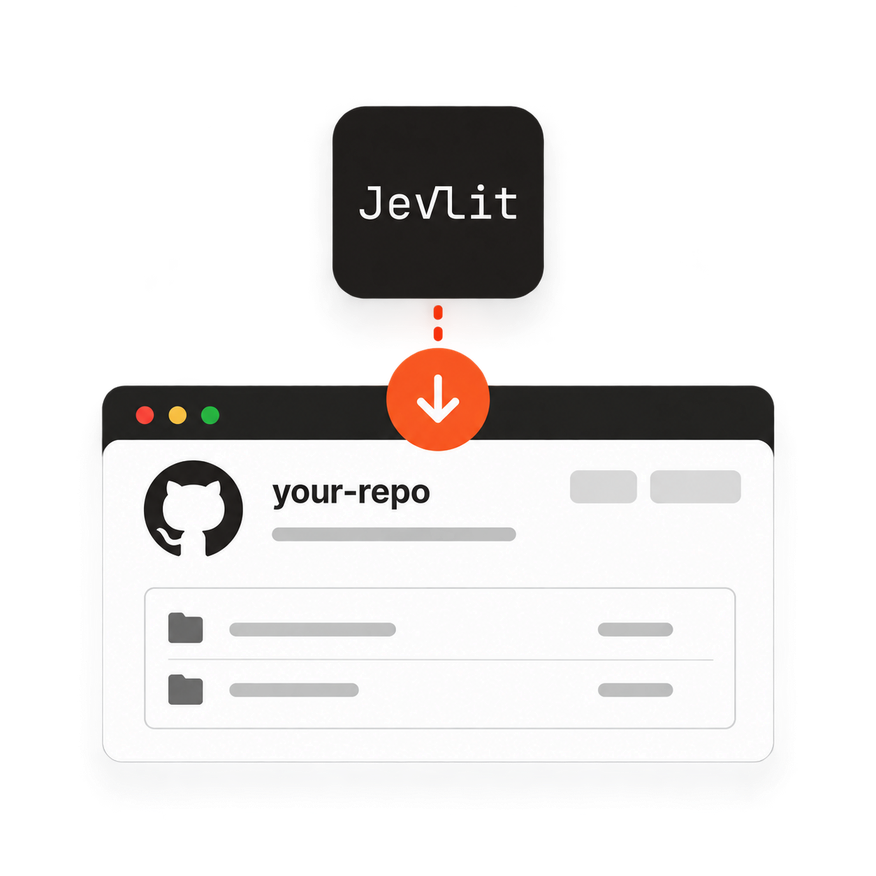
Install on your repo
Add the app to a repository. It needs no config file and no workflow of its own, so there is nothing to maintain once it is running.

Jevlit reviews the diff instead of the whole repository. One model call per changed function, a median verdict in 0.68 s, and a bill of $0.010 where the agent we put it against spent $0.147 on the same repository. 15 times less, for a review that names the function and quotes the line.
Add the app to a repository. It needs no config file and no workflow of its own, so there is nothing to maintain once it is running.

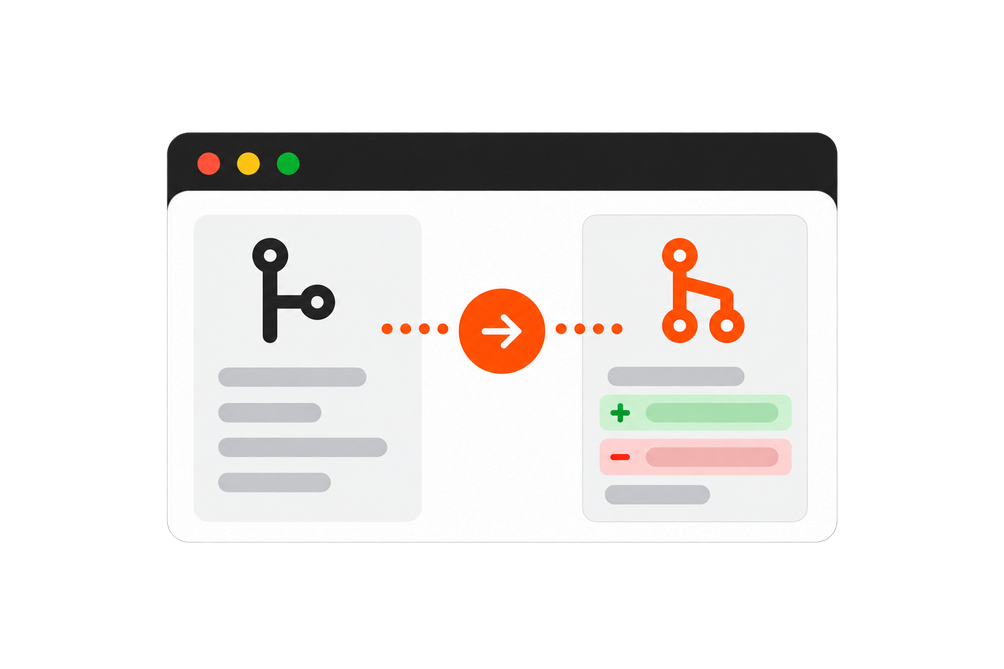
Jevlit reads the diff and makes one model call per changed function. The calls run in parallel, and none of them is about code you did not touch.

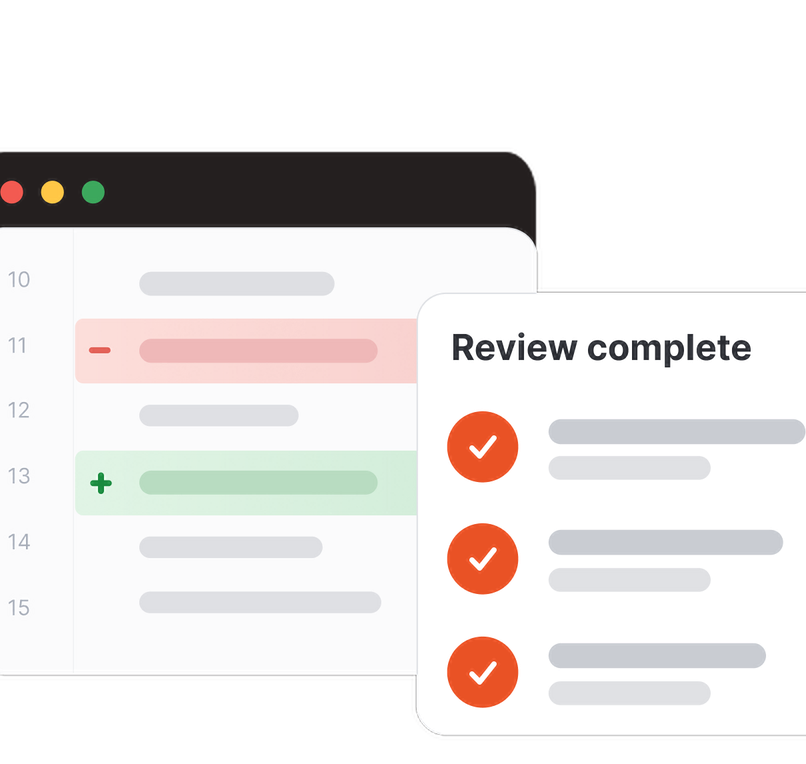
Each function gets its verdict in 0.68 s at the median, and the result lands on the pull request as a check. Every finding names its function, quotes its line and carries a probability.
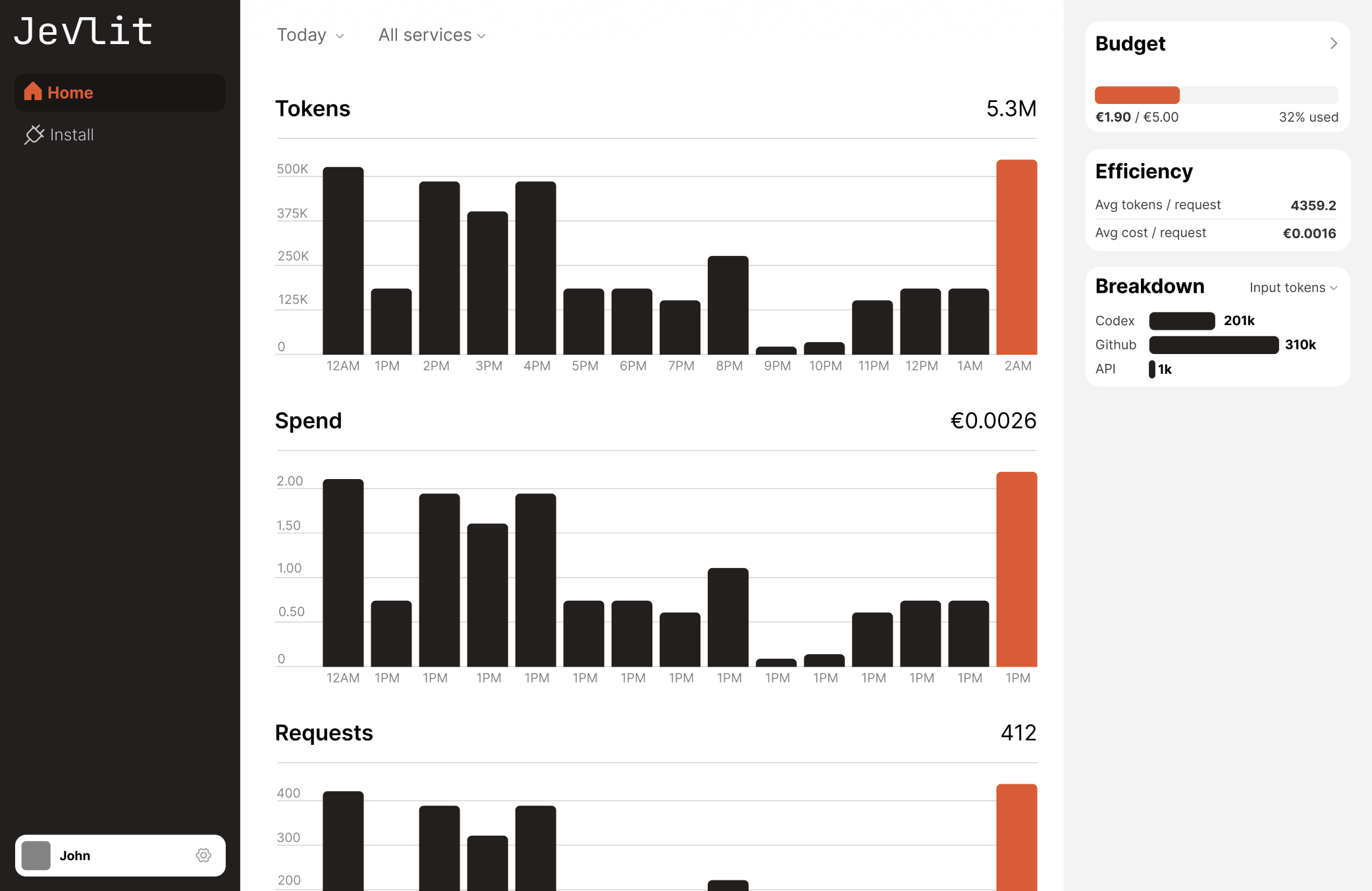
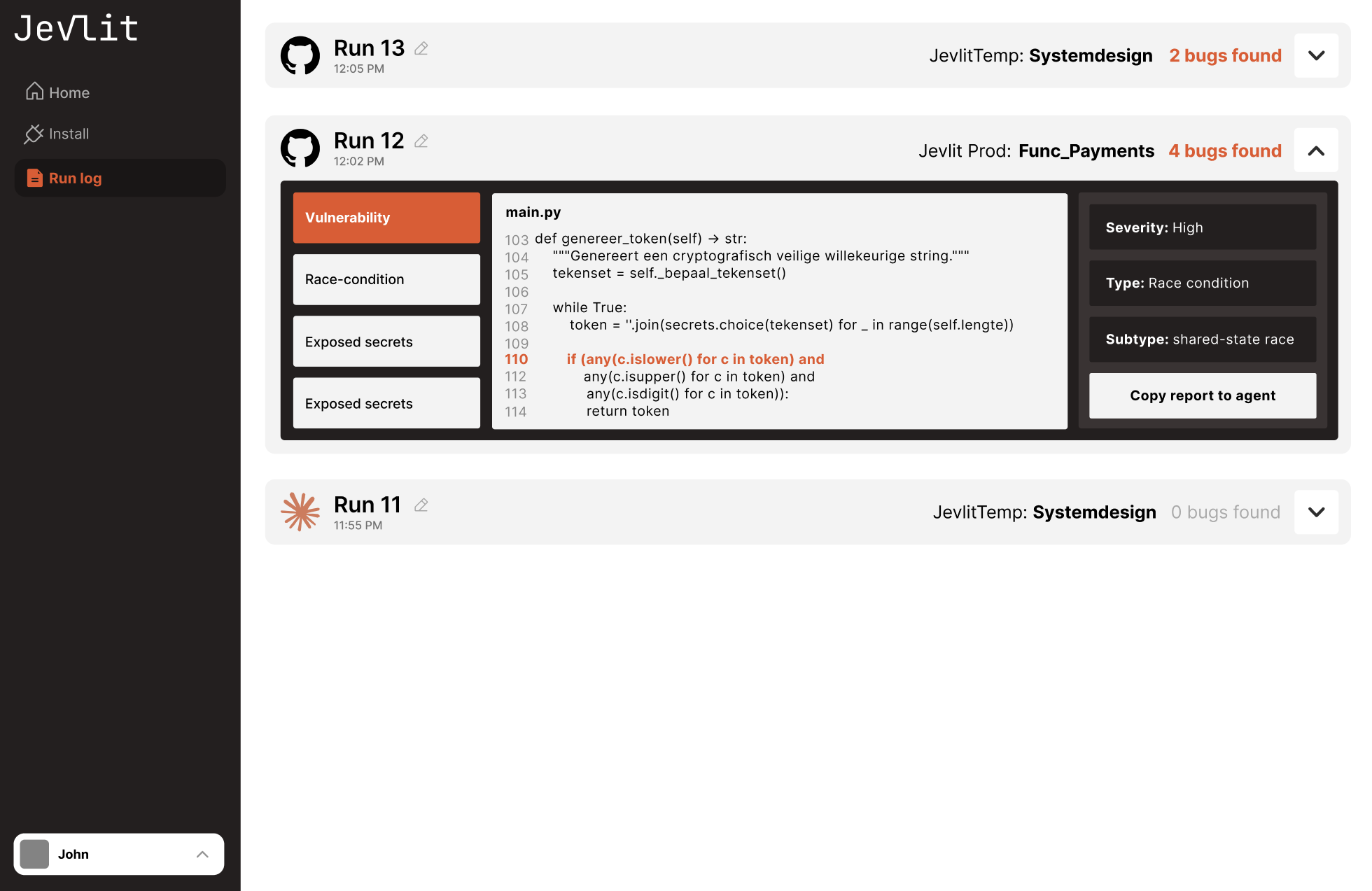
Runs are kept with the finding, the code around it and the probability behind it, so you can hand the whole report to your agent instead of digging through a CI log.
Go to run logTokens, spend and requests for every service in one place. Set a budget per repository and watch what each service costs against it. Scans are billed at €0.02, and the model bill behind them counts input tokens only.
Go to consoleOne scan of dsvpwa costs us $0.010, against $0.147 for GPT-5.6 Terra and $3.11 for GPT-6 Astra, which is 311× ours. On the same 32 labelled bugs, matched one-to-one by line, we score 15 of 32 against 21 for Terra: cheaper, not sharper.
Read the methodOne model call per changed function, run in parallel. Nothing else in the repository is read, so the bill scales with the size of the change rather than the size of the codebase.
Jevlit runs on TypeSafe System One. Every question it asks about your code comes back as a typed value with a probability attached, rather than as prose you have to read and interpret.
The line that turns a probability into a flag is frozen at 0.70. It is never tuned against an answer key, so it behaves on your code the way it behaved in the benchmark.
On 177 real bug-and-fix pairs it had never seen, the shipped engine raised an alarm on 7 of the fixed files, and on 7 of 172 ordinary commits.
That quiet is a trade and here is its price. At 0.70 the shipped engine caught 47 of 177 held-out bugs, about one in four. We would rather hand you four findings you read than thirty you learn to skip.
A decision costs about 1.5k tokens of input, and output is free. Ten thousand reviews come to $1.46.
Jevlit is available to enterprise clients on a flexible, pay-as-you-go plan: €0.02 per scan, with no seat licences, no minimum spend, and a cap you set per repository.
View pricing
Install Jevlit as a plugin and it reviews the working tree before you commit. You get the same verdict the pull request would give you, one step earlier.
Install pluginOn the same 79 real bug-and-fix pairs from 35 open-source projects, Jevlit flagged 22 bugs with 1 false alarm on the fixes. ruff's bug rules flagged 7 with 4; pylint flagged 11, with 11 false alarms. 17 of Jevlit's catches were missed by every free tool we ran.
A review comes back while you are still looking at the diff: 0.68 s at the median, 0.79–0.94 s at the 95th percentile.
The price is the same whoever opened the pull request, so you can add the whole team without adding a line to the invoice.
Tokens, spend and requests per service, per day, with the budget you set drawn across the top of them.
Jevlit installs as a Codex plugin in one command and reviews from your terminal exactly as it does on a pull request.
Jevlit is billed on the tokens it reads. A decision is about 1.5k tokens of input at $0.042 per million, and the output it writes back is free.
That puts one review at $0.00015, ten thousand of them at $1.46, and the branch we measured — 122 diffs, reviewed one at a time — at $0.0179.
On the head-to-head repository it spent $0.010 where GPT-5.6 Terra spent $0.147: 15 times less, on a scan that matched 15 of 32 against 21 one-to-one by line.
Every figure on this page names the run it was measured in, and the ones that do not flatter us are on the page too.
One repository, one answer key, and the axis is the bill — the only quantity measured the same way for every row. On what they caught we are behind: 15 of 32 against 21 for Terra when both are matched one-to-one by line. On what they cost, it is a fifteenth of the money.
Every scanner beside us on these charts is a public run from the RealVuln dashboard, priced from its own run metadata. Ours is the same repository and the same answer key; because Jevlit does not output CWEs it is matched by file and line only, and its find count is shown beside the bars, never drawn.
dsvpwa was written to be vulnerable. Flag every function in it without reading one and you score 20 of 32, which is why we chart what a scan costs rather than what it caught, and why the count beside our bar is the smaller of the two we have.
Install the app and open a pull request. There is no YAML to write and no runner to keep warm, and removing it later leaves nothing behind.
Read the docsGitLab and Bitbucket are on the way. The review is the diff and a set of typed questions, so the only part that changes is where the comment gets posted.
Ask for itJevlit answers in typed values rather than essays, so the expensive half of an LLM bill never happens.
These are real defects and the commits that fixed them, taken from BugsInPy — a set someone else collected and labelled — rather than from examples we wrote for ourselves.
The slow reviews are still under a second: 0.79–0.94 s at the 95th percentile across three suites.
The editor extension is the next thing we are building: the same typed question on the function under your cursor, before the diff is even a diff.
Ask for itThe bill we actually ran up reviewing one branch of real work: 122 diffs, one review each, $0.0179 the lot.
New accounts get €3 in credits, which is 150 pull-request scans, before anyone asks you for a card.
Sign up today and receive €3 in credits for free, enough for 150 pull-request scans. Jevlit is currently open to developers and authorized testers.